Veronika Wenger
Oleksiy Koval
Ornament and Rhythm as Principles of Gestaltung: Making the Invisible Visible
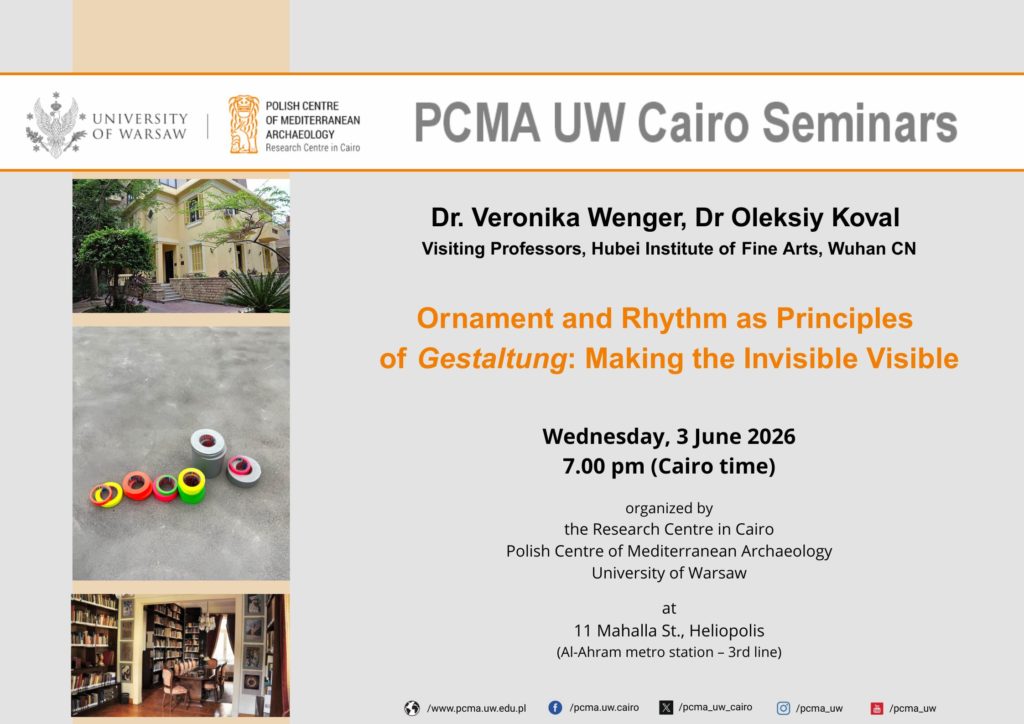
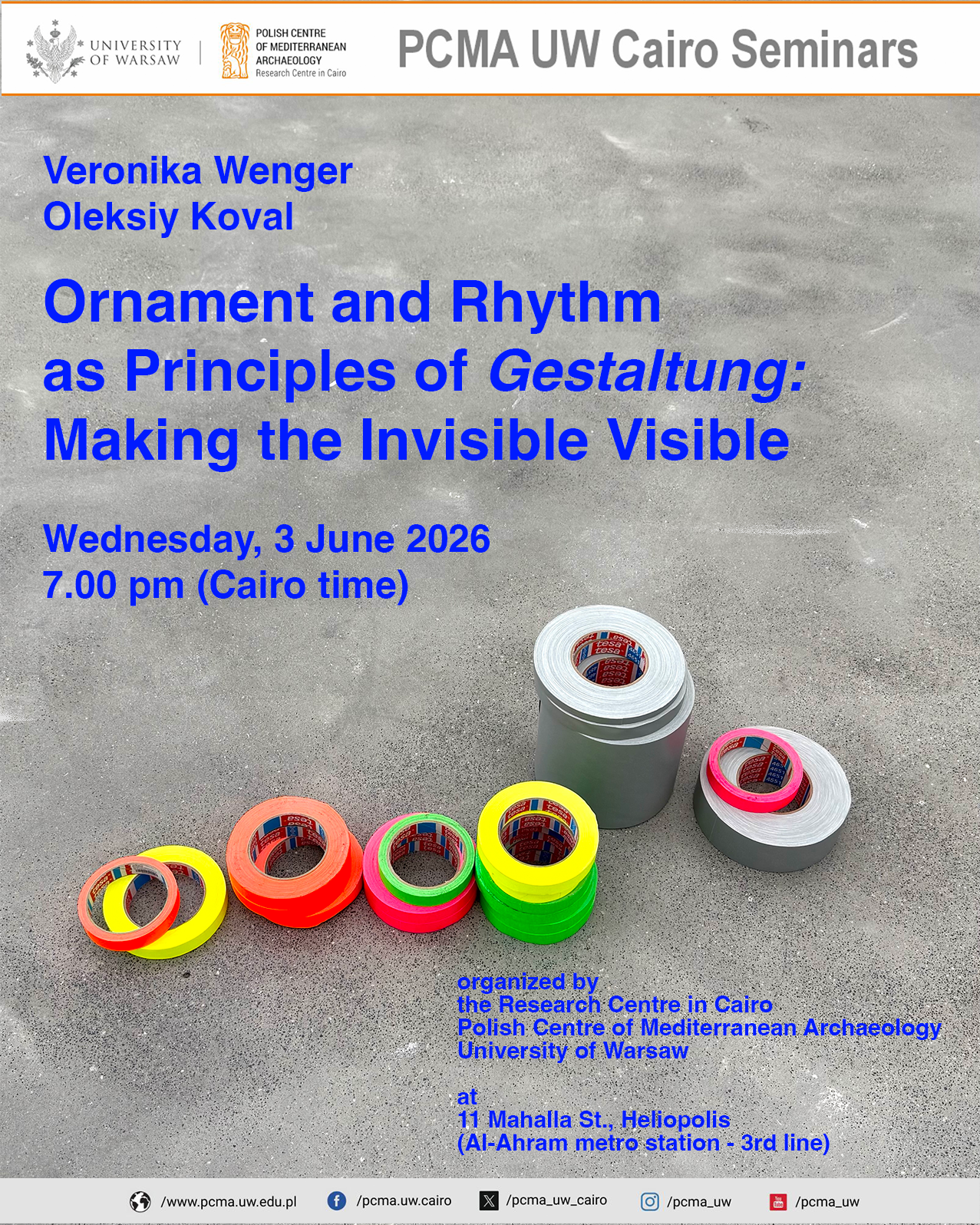
On Wednesday, June 3rd, the PCMA UW Cairo Seminars continue at the PCMA Research Centre in Cairo. Dr. Veronika Wenger and Dr. Oleksiy Koval (Visiting Professors, Hubei Institute of Fine Arts, Wuhan CN) will deliver a lecture: “Ornament and Rhythm as Principles of Gestaltung: Making the Invisible Visible”.
The lecture draws on Spencer-Brown’s calculus of forms and Luhmann’s systems theory: ornament and rhythm become legible as the basal operation of distinction — as a concatenation of distinctions that does not represent reality, but constitutes it.
Through gold as colour space, Byzantine mosaics and Giotto’s halos, the concept of disegno, the enigmatic inscription “Mene, Tekel, Peres,” divine judgement and re-entry, Hölderlin and Cézanne, contemporary drawing and the concept of “The Beautiful Formula” — the sacred is not depicted, but made possible.
The lecture thus bridges Byzantine ornament, early modern painting, Old Testament scripture and modern systems theory, showing ornament and rhythm as the operative structure of the world in which the invisible becomes visible.
The seminar will be held on Sunday, June 3rd at 7 pm (Cairo time) at the PCMA UW Research Centre in Cairo, 11 Mahalla St., Heliopolis.
The lectures showcase projects carried out by expeditions of the Polish Centre of Mediterranean Archaeology, University of Warsaw, as well as teams collaborating with the PCMA. The series also features distinguished scholars from other academic institutions whose work significantly contributes to our understanding of Egypt and the region’s past.
This lecture series presents the latest research on Egypt’s heritage — from Antiquity to the modern period — and, in selected cases, on the heritage of neighboring countries. The topics cover the broadest possible spectrum, ranging from archaeological and historical studies to research on material culture, art, religion, and society.
The series is coordinated by Dr. Anastasiia Stupko-Lubczynska (Head of the Department of Egyptian Archaeology) and Tomasz Kania (Head of PCMA Research Centre in Cairo).
Special thanks to Dr. Maciej Wacławik.